
35 Years of Indian Economic Liberalisation: The Reforms That Transformed a Nation
July 24, 2026, marks 35 years of India's economic liberalisation journey—a landmark moment that changed the trajectory of one of the world's largest economies. What began as a response to a severe economic crisis in 1991 evolved into a transformative reform movement that opened India's doors to global markets, encouraged private enterprise, and laid the foundation for decades of economic growth.
7/24/20264 min read
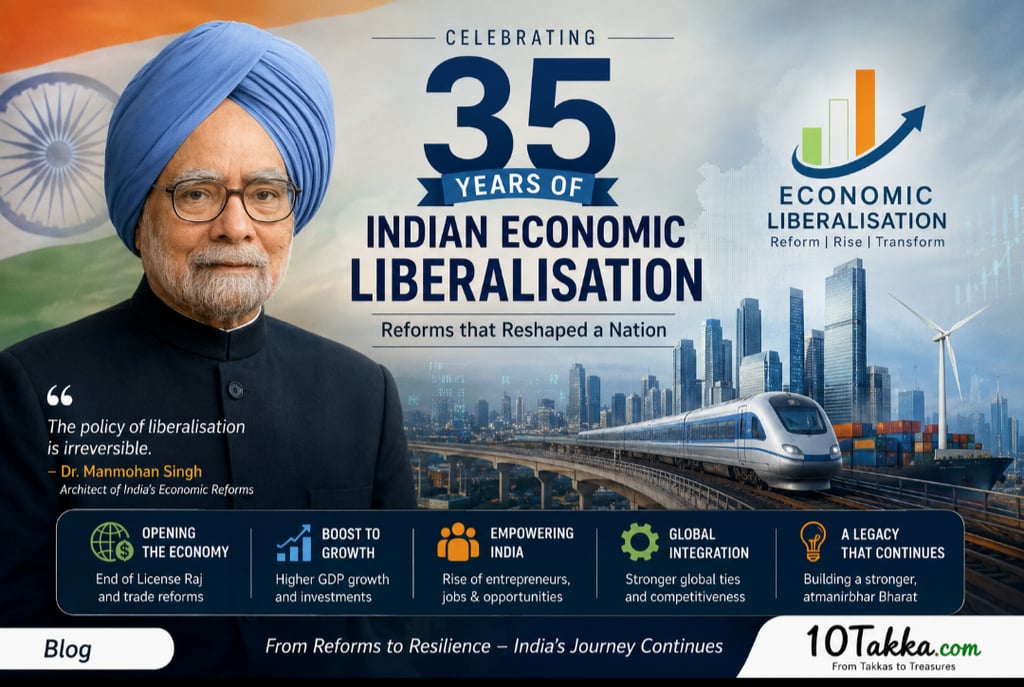
As India celebrates 35 years of liberalisation, it is worth reflecting on how these reforms reshaped industries, created opportunities, reduced poverty, and positioned the country as a major global economic power.
The Crisis That Triggered Reform
In 1991, India faced one of the most challenging periods in its economic history. Foreign exchange reserves had fallen to levels sufficient for only a few weeks of imports. Inflation was rising, fiscal deficits were widening, and economic growth had slowed significantly.
To stabilize the economy, the government led by Prime Minister P.V. Narasimha Rao appointed Dr. Manmohan Singh as Finance Minister. Together, they introduced a series of bold reforms that fundamentally altered India's economic framework.
These reforms marked the beginning of what is commonly known as India's economic liberalisation.
What Was Economic Liberalisation?
Economic liberalisation refers to reducing government controls and restrictions on economic activities while promoting market-driven growth.
The reforms focused on three key pillars:
1. Liberalisation
Reduction of licensing requirements and government controls over businesses.
2. Privatisation
Encouraging greater participation of private companies in sectors previously dominated by the public sector.
3. Globalisation
Integrating India with the global economy through trade and foreign investment.
Together, these policies transformed India's economic landscape.
Key Reforms Introduced in 1991
End of the Licence Raj
For decades, businesses required multiple government approvals to establish or expand operations. The reforms dismantled much of this cumbersome system, making it easier for entrepreneurs to start and grow businesses.
Opening to Foreign Investment
India eased restrictions on Foreign Direct Investment (FDI), allowing global companies to invest in Indian industries.
This brought:
Capital inflows
Advanced technology
Better management practices
Employment opportunities
Trade Reforms
Import duties were gradually reduced, and restrictions on international trade were relaxed. Indian businesses gained access to global markets while consumers benefited from greater product choice.
Financial Sector Reforms
The banking and financial sectors underwent modernization, leading to:
Improved efficiency
Stronger capital markets
Greater access to finance
Enhanced investor participation
Currency Reforms
The Indian Rupee moved toward a market-determined exchange rate, helping improve export competitiveness and foreign investment flows.
The Impact on India's Economy
Rapid Economic Growth
Before liberalisation, India's GDP growth often hovered around 3-4%, sometimes referred to as the "Hindu Rate of Growth."
Post-reforms, growth accelerated significantly, with India emerging as one of the world's fastest-growing major economies.
Today, India ranks among the largest economies globally and is widely expected to become the world's third-largest economy in the coming years.
Rise of the Middle Class
Liberalisation helped create millions of jobs across sectors such as:
Information Technology
Telecommunications
Banking
Retail
Manufacturing
Financial Services
As incomes increased, a large middle class emerged, driving consumption and economic activity.
Technology Revolution
India's globally recognized IT industry owes much of its success to the reforms of the 1990s.
Companies such as Infosys, TCS, Wipro, and HCL expanded rapidly, transforming India into a global technology hub and outsourcing destination.
Consumer Choice Expanded
Before liberalisation, consumers had limited options for many products.
Today, Indian consumers enjoy access to:
Global brands
Advanced technologies
Better quality products
Competitive pricing
Competition has encouraged innovation and improved service standards across industries.
Foreign Investment Surge
India became an attractive destination for multinational corporations.
FDI inflows have supported:
Infrastructure development
Manufacturing expansion
Employment generation
Technology transfer
Sectors That Benefited the Most
Information Technology
The IT industry emerged as one of India's greatest success stories, generating exports worth billions of dollars annually.
Telecom
From a time when obtaining a telephone connection could take years, India has become one of the world's largest telecom markets with affordable connectivity.
Automobile Industry
Global automobile manufacturers entered India, increasing competition and expanding consumer choice.
Financial Services
The banking, insurance, and capital market sectors became more sophisticated and accessible.
Start-Up Ecosystem
India is now home to one of the world's largest start-up ecosystems, producing numerous unicorns across fintech, edtech, ecommerce, logistics, and SaaS sectors.
Challenges and Criticisms
While liberalisation delivered substantial benefits, it also brought challenges.
Income Inequality
Economic growth was not evenly distributed. Some regions and groups benefited more than others, leading to concerns about income disparities.
Agricultural Concerns
Many farmers faced increased market competition and fluctuating commodity prices.
Employment Quality
Although jobs were created, concerns remain regarding skill gaps and the availability of high-quality employment opportunities.
Regional Imbalances
States with better infrastructure and policies attracted more investment, creating uneven development across regions.
These challenges continue to shape policy discussions today.
The Evolution of Reforms
Economic liberalisation did not end in 1991.
Successive governments have continued reforms through initiatives such as:
GST implementation
Insolvency and Bankruptcy Code (IBC)
Digital India
Make in India
Production Linked Incentive (PLI) schemes
Startup India
National Infrastructure Pipeline
These measures aim to strengthen India's competitiveness in an increasingly interconnected global economy.
India at 35 Years of Liberalisation
As India marks 35 years of economic reforms, the country stands at a unique point in history.
India is:
One of the world's fastest-growing major economies
A global technology powerhouse
A leading start-up hub
A major destination for foreign investment
A critical player in global supply chains
The reforms of 1991 created the foundation for these achievements.
However, the next phase of growth will require continued focus on:
Education and skills
Manufacturing competitiveness
Infrastructure development
Sustainable growth
Employment generation
Inclusive prosperity
Conclusion
The story of Indian economic liberalisation is ultimately a story of transformation.
What began as an emergency response to an economic crisis evolved into a long-term growth strategy that reshaped industries, empowered entrepreneurs, improved consumer choice, and elevated India's position on the global stage.
Dr. Manmohan Singh famously stated that "no power on earth can stop an idea whose time has come." Thirty-five years later, the impact of those reforms continues to influence every aspect of India's economy.
As the nation celebrates this milestone, the focus shifts toward the future—building an economy that is not only larger but also more innovative, inclusive, and resilient.
The journey that started in 1991 is far from over. In many ways, India's next chapter of economic transformation is just beginning.
From Reforms to Resilience—India's Growth Story Continues.
#IndianEconomicLiberalisation #EconomicReforms #IndiaAt35 #ManmohanSingh #PVNarasimhaRao #IndianEconomy #EconomicGrowth #Liberalisation1991 #Globalisation #FDI #MakeInIndia #DigitalIndia #StartupIndia #IndianMarkets #BusinessNews #Economy #GDPGrowth #IndiaGrowthStory #Finance #10Takka #10TakkaUpdates